
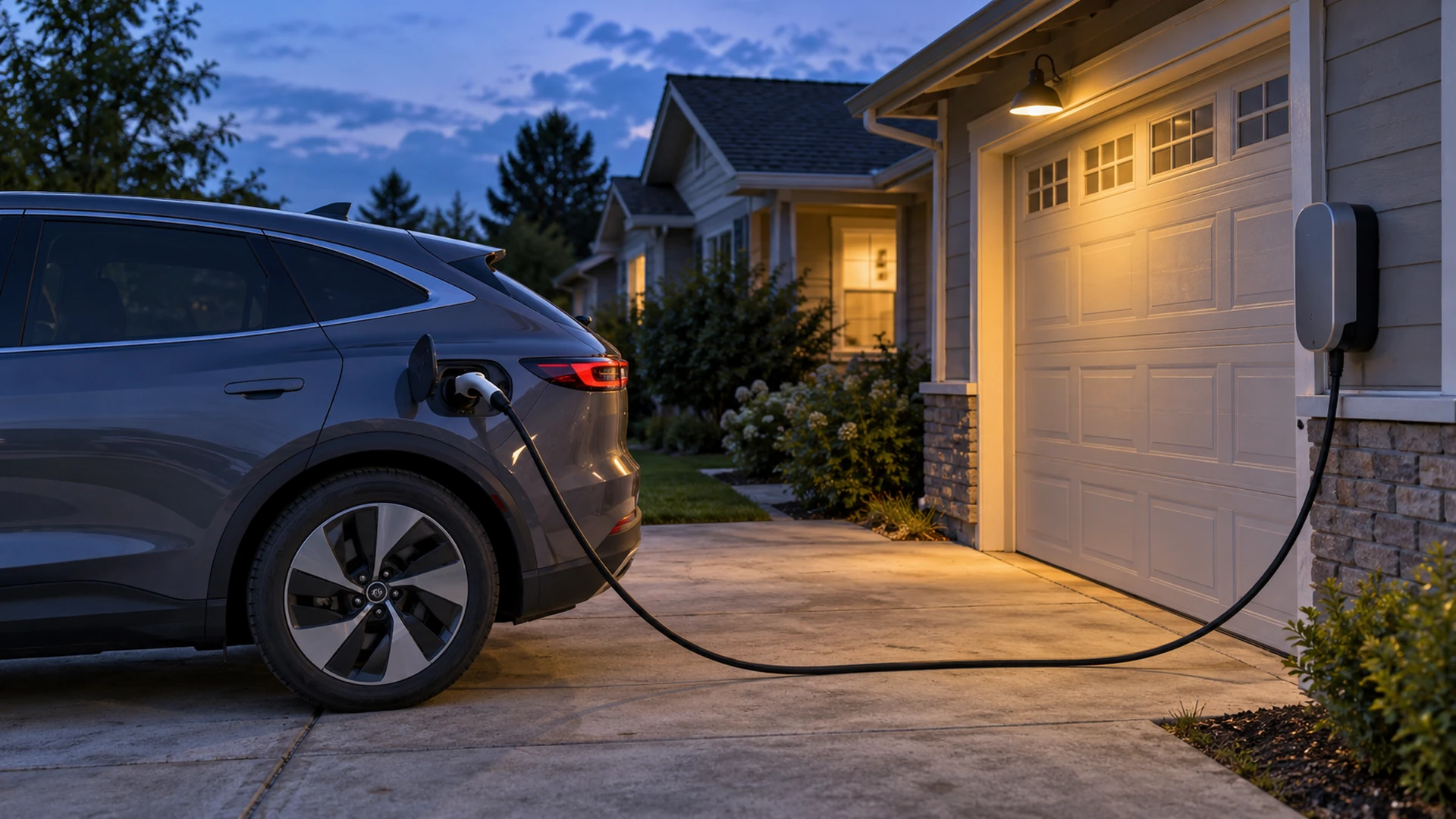
How much does it cost to charge an electric car at home? Your bill buys electricity at the wall, not miles on the dashboard. The useful answer comes from your driving, your actual tariff and the energy needed to replace those miles—not a universal monthly price.
For a worked example, 1,000 miles at 30 kWh per 100 miles and $0.20 per kWh costs $60. Those are illustrative inputs, not a national average or a promise for your vehicle. Below, you can change them, compare gasoline, and check whether a cheaper charging window really reduces your household bill.
Table of Contents
- The formula and a worked example
- What counts in your rate?
- Why a state average is not your price
- Compare electricity with gasoline
- Check time-of-use plans
- Personal charging-cost calculator
- Do you need Level 2?
- Winter and real-world use
- Check the first full bill
- FAQ
- Budget From Your Own Inputs
For the wider equipment decision, our home EV charging station guide covers charging levels and installation. This page focuses on ongoing energy cost, separately from buying the charger.
The Formula: Keep the Energy Basis Consistent
Monthly home charging cost = home-charged miles × wall energy per mile × applicable electricity rate. If the consumption figure is expressed in kWh per 100 miles, divide it by 100 first. Count only the miles replaced by home charging; public charging belongs on a separate line.
Example: 1,000 miles × 30 kWh/100 miles = 300 kWh. At $0.20/kWh, that is $60. At $0.35/kWh, the same energy costs $105. The vehicle has not changed; the tariff has.
| Illustrative monthly miles | Wall consumption | Monthly kWh | At $0.20/kWh |
|---|---|---|---|
| 500 | 30 kWh/100 mi | 150 | $30 |
| 1,000 | 30 kWh/100 mi | 300 | $60 |
| 1,500 | 30 kWh/100 mi | 450 | $90 |
| 1,000 | 40 kWh/100 mi | 400 | $80 |
A dashboard’s battery-use figure may omit energy lost while charging. EPA label consumption is measured on a wall-energy basis that includes charging losses; the EPA testing explanation describes that boundary. Do not add a second charging-loss allowance when your consumption number already accounts for it. For your exact model, consult FuelEconomy.gov; for your own use, compare a charging-session meter with the miles driven over the same period.
For a partial refill, use the energy actually taken from the supply. Multiplying the advertised battery capacity by your rate can be a rough illustration, but it is not an exact session bill: starting charge, usable capacity, losses and conditioning all matter.
What Counts in Your Electricity Rate?
The line labeled “energy charge” may be only part of the marginal price. Check variable supply, delivery and other per-kWh charges. If a flat customer charge stays the same whether or not you charge the car, it is not an incremental charging cost.
A new plan can change that distinction. An EV tariff might add a monthly fee, move the whole house onto time-of-use pricing, or apply only to a separately metered circuit. Include any new fee and the effect on the rest of the home’s electricity when comparing plans.
Tiered rates need similar care. The next 300 kWh may fall into a different tier than your current household average. Dividing the old total bill by its kWh is a useful first approximation, but the tariff is the better guide to what additional charging will cost.
Why a State Average Is Not Your Charging Price
State averages are background, not a household quote. Two neighbors can have different suppliers, plans, discounts or eligibility. The EIA’s monthly electricity data can provide context, but your current tariff and bill are the inputs to use for a purchase decision.
Compare the rate at the hours you can actually charge. A low advertised overnight number may exclude delivery, fees or conditions; a higher all-in rate may be the more honest comparison. Keep a copy of the tariff and its effective date rather than relying on an old state-ranking graphic.
EV Charging Cost vs. Gas: Compare Like With Like
For gasoline, cost per mile is price per gallon divided by miles per gallon. For electricity, use wall kWh per mile multiplied by the applicable rate. Compare the same distance and label the assumptions.
With the example above, 1,000 miles costs $60 in electricity. A hypothetical 30-mpg gasoline car at $3.60/gallon uses about 33.3 gallons and costs $120 for the same distance. The illustrative energy-cost difference is $60 per month, or $720 if those inputs hold for a full year.
That is a fuel comparison, not total ownership savings. Insurance, financing, depreciation, installation, tires, servicing and public charging can change the result. Electric car maintenance cost and EV battery replacement cost deserve their own model-specific assessment; they should not be slipped into a fuel-savings number as an automatic bonus.
Check a Time-of-Use Plan Before Switching
Some utilities offer EV or time-of-use rates. They can reward flexible charging, but there is no universal overnight window or percentage discount. Get the actual peak and off-peak hours, weekend and seasonal rules, variable charges, fixed fees and enrollment conditions.
A simple comparison helps: at an illustrative 300 kWh per month, moving the charging price from $0.20 to $0.10 saves $30 on charging energy. If the new plan also adds fees or raises the cost of daytime air conditioning, the household saving will be smaller and could disappear.
Ask your utility whether it can compare the plans using your interval data. If the plan works, set the car or charger schedule to that tariff’s real window. Do not assume that “after 9 p.m.” is cheapest everywhere, or that a cheap tariff compensates for an unsuitable electrical installation.
Home EV Charging Cost Calculator
These starting values illustrate the calculation. Replace them with your own figures. Use wall-energy consumption, including charging losses; do not add those losses again.
Energy only. Excludes added plan fees, demand charges, charger installation, public sessions and other ownership costs.
Do You Actually Need Level 2?
Decide from daily energy to replace and hours parked, not battery size alone. A large battery used for a short commute does not necessarily need a fast nightly refill. Conversely, an inefficient vehicle, cold weather or a short parking window can make a slow charge inadequate.
Check whether your vehicle includes a portable charging cord; it is not universal. Use only approved equipment on a suitable installation. DOE’s home-charging guidance explains why some drivers meet their needs with Level 1 while others benefit from Level 2.
Our Level 1 versus Level 2 guide covers that choice. If an upgrade is worthwhile, separate it from the ongoing energy budget using the installation-cost guide.
Winter and Real-World Efficiency
Temperature, speed, cabin conditioning, terrain and trip length affect consumption. The effect is vehicle- and journey-specific, so a single winter percentage should not be applied to every EV.
For an explicit sensitivity check, change the calculator’s wall consumption from 30 to 40 kWh per 100 miles. At 1,000 miles and $0.20/kWh, the modeled bill rises from $60 to $80. That shows what higher use does to the budget without claiming that every winter produces that change.
Use seasonal charging records when you have them. DOE/EPA’s energy-flow explanation describes charging and accessory losses; those effects are not a guarantee that a particular household will save money.
Check the First Full Month
- Compare miles, charging-session kWh and the tariff for the same dates.
- Separate home charging from public sessions and subscriptions.
- Check whether peak pricing, tier changes or a new fee explain a difference.
- Compare other home use before blaming the whole bill increase on the car.
There is no universal six-cents-per-mile cutoff for “overpaying.” A high local rate or an energy-intensive vehicle can legitimately produce a larger number. If the broader household increase is unexplained, our electric-bill guide helps separate possible causes.
Frequently Asked Questions
Budget From Your Own Inputs
Keep three numbers together: miles replaced at home, wall energy for those miles, and the applicable electricity price. Then compare the complete tariff before changing plans. That produces a useful budget without requiring a new charger, a paid calculator or a national-average promise.
These calculations illustrate energy costs, not total vehicle ownership costs or a guaranteed bill reduction. Verify your current tariff, equipment instructions and installation needs with the relevant provider or qualified professional.