
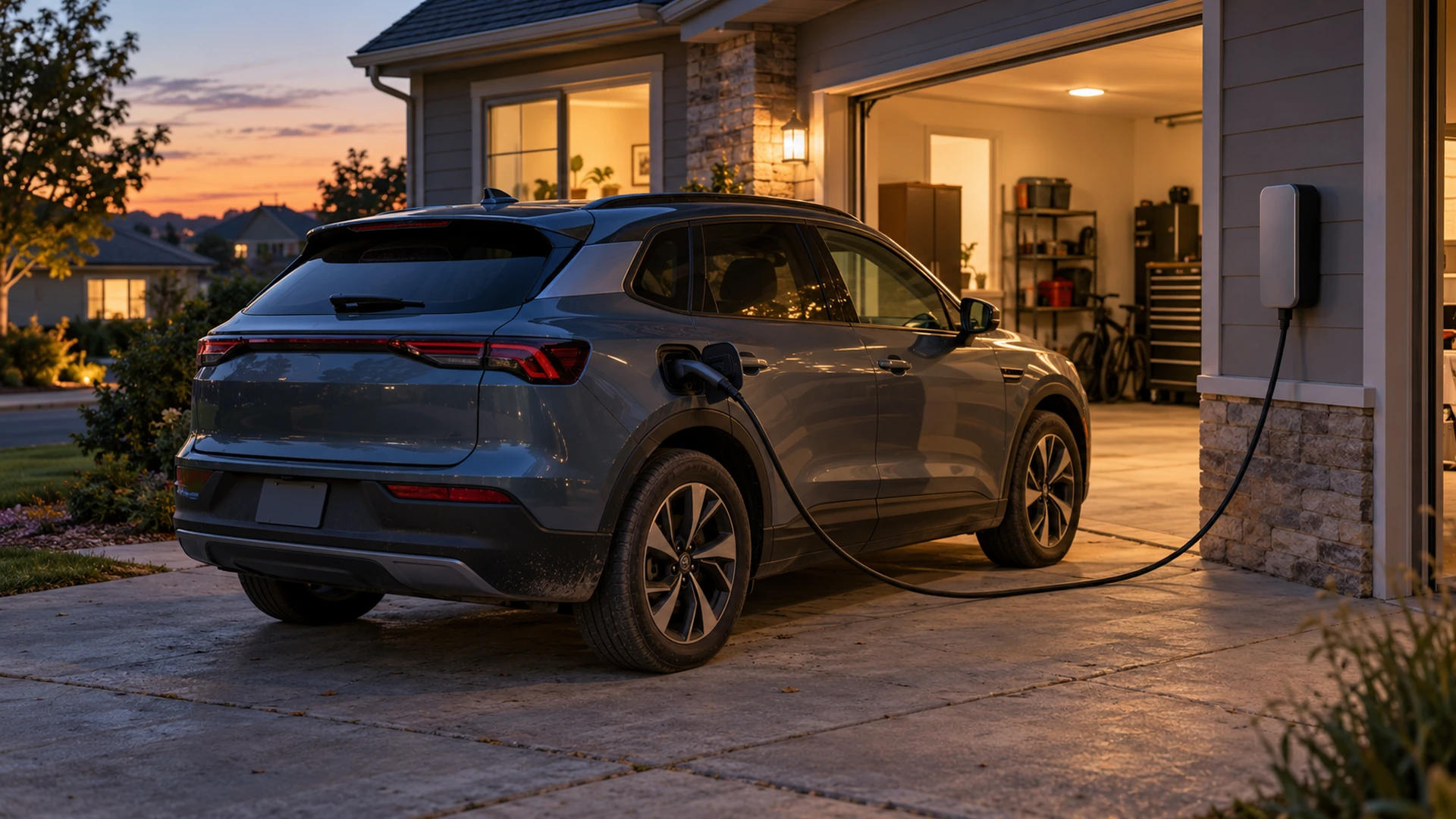
Your EV may hold far more energy than a home battery, but a large battery is useless to the house without a compatible backup system. A bidirectional EV charger is one part of that system: the vehicle, conversion equipment, home isolation and software must all work together.
This guide separates vehicle-to-home charging from ordinary charging and appliance outlets, explains the decisions that drive an installed quote, and shows how to estimate backup duration without mistaking battery capacity for available power.
For the wider charging decision first, use our home EV charging station guide. Here, the question is narrower: can your particular car keep the loads you need running during an outage?
This page contains affiliate links. We may earn a commission if you use them, at no extra cost to you. Paid links are identified in their link treatment. Affiliate Disclosure.
Table of Contents
- V2H, V2G, and V2L: What They Actually Mean
- Does Your Car Qualify? Check the Exact Configuration
- Home-Backup Systems: What You Are Actually Buying
- Bidirectional EV Charger Cost: Compare Complete Quotes
- Backup Energy Estimate
- Whole-Home or Selected Loads?
- Battery Wear, Reserve and Warranty
- V2H or a Dedicated Home Battery?
- A Decision Framework Before You Spend
- What to Ask Before Installation
- Bidirectional EV Charger FAQ
- What to Do Next
V2H, V2G, and V2L: What They Actually Mean
| Function | What it supplies | What to verify |
|---|---|---|
| V2L: vehicle to load | Individual appliances through an approved vehicle outlet or adapter | Supported equipment and outlet limits; this is not permission to feed a home receptacle |
| V2H: vehicle to home | Approved home circuits during an outage | Vehicle export support, compatible conversion/control equipment and safe grid isolation |
| V2G: vehicle to grid | Export to the utility grid under a participating program | Approved vehicle/system, interconnection agreement, tariff and enrollment |
A car can support one function without supporting the others. An outlet adapter for camping does not turn an ordinary Level 2 charger into a bidirectional home-backup system.
Never backfeed a home through a wall outlet. A home connection needs equipment and installation designed for that vehicle and the local electrical requirements.
Does Your Car Qualify? Check the Exact Configuration
Compatibility is a vehicle-and-home-system question, not a brand badge. Before paying a deposit, obtain written confirmation for your model year, trim, software and proposed hardware.
| Route | What the manufacturer documents | Buying check |
|---|---|---|
| F-150 Lightning | Ford Home Backup Power uses a Charge Station Pro and Home Integration System | Battery/trim, software activation, equipment version and installer requirements |
| GM Energy | Selected Chevrolet, GMC and Cadillac EVs work with a PowerShift Charger and V2H Enablement Kit | Exact model-year eligibility and any required software update |
| Tesla Powershare | Cybertruck has a route without Powerwall; eligible Model 3/Model Y vehicles can extend Powerwall backup | Vehicle support screen, firmware, home configuration and installer confirmation |
| Other vehicles/platforms | Capability varies; a standard or demonstration is not a vehicle approval | A current manufacturer compatibility list and an installable system for your address |
Use GM’s model-year list and Tesla’s configuration requirements rather than assuming every vehicle in a family is supported. Tesla’s published requirements now include certain Model 3 and Model Y vehicles; older blanket claims that none can participate are unreliable.
If backup is not supported or not worth the extra equipment, our Level 2 charger comparison covers ordinary charging. Those products should not be bought with an assumed V2H upgrade path.
Home-Backup Systems: What You Are Actually Buying
Ford Home Backup Power
The Lightning route combines the Charge Station Pro with a Home Integration System. Ford documents up to 9.6 kW of backup output. That is a power limit, not the service rating of the home: it does not mean every appliance on a 200A panel can run together.
Confirm whether your vehicle needs a paid software activation; Ford distinguishes standard-range and extended-range arrangements. Do not assume equipment bundled with a previous vehicle purchase is included in a new quote. Ask which loads can start and run, how reserve is set, and who commissions the complete system.
GM Energy: charger plus home equipment
A PowerShift Charger alone does not supply home backup. GM pairs it with an enablement kit containing the home hub, inverter and a dark-start battery. GM specifies 9.6 kW of inverter backup power and supports whole-home or partial-home configurations, depending on the installation.
The dark-start battery wakes the system during an outage; it is not a substitute for a substantial stationary home battery. If you want storage that remains available when the car leaves, ask about a separate storage system. See GM’s kit contents and specifications.
Tesla Powershare: the home configuration matters
Cybertruck can support home backup with a Powershare Gateway and Universal Wall Connector without requiring Powerwall. Supported Model 3/Model Y vehicles use a different route with Powerwall and compatible charging equipment. Tesla’s documentation describes how to check vehicle support; ownership of a Wall Connector alone proves neither route is enabled.
Enphase and emerging platforms
Enphase has demonstrated an IQ Bidirectional platform and targeted volume production beginning in Q4 2026. Its announcement explicitly makes compatibility dependent on automaker enablement, software and final specifications. A production target is not a promise that any standards-compatible car can be installed today.
For a purchase, request an orderable equipment list, approved vehicle match and installation date. Enphase’s announcement explains the distinction between demonstrations and final compatibility.
Bidirectional EV Charger Cost: Compare Complete Quotes
A charger-only price is not an installed backup price. Compare quotes for the same backed-up loads and the same vehicle; otherwise a cheaper proposal may simply omit equipment or site work.
| Quote line | What it should explain |
|---|---|
| Vehicle-side equipment | Exact charger/connector, supported vehicle and activation fees |
| Home backup equipment | Inverter, gateway/transfer equipment, controls and any required start battery |
| Electrical work | Load assessment, cable route, circuit/panel changes and load-management equipment |
| Installation and approvals | Labor, permits, utility requirements, commissioning and outage demonstration |
| Aftercare | Separate vehicle and equipment warranties, service responsibility and exclusions |
Request a gross installed total before incentives, an itemized scope, and the price of any exclusions. Previous hardware prices and promotional bundles are poor substitutes for a current quote. Do not calculate a home-backup discount by dividing only the charger price by the entire vehicle battery.
Tax treatment is a separate check. The federal residential clean-energy credit is not available for new installations completed after 2025, and the residential charging-property credit ended for equipment placed in service after June 30, 2026. Do not assume a vehicle battery or integration kit automatically qualifies as residential storage. Use the IRS termination guidance for the relevant project and tax year.
Backup Energy Estimate
Use your vehicle’s usable battery capacity and your chosen backup loads. This is an energy illustration, not a compatibility check, a starting-load calculation or a guarantee of runtime.
The illustration assumes 85% of the energy between starting charge and reserve reaches the home. Replace that assumption with your system’s planning data; weather and standby consumption can change the result.
Whole-Home or Selected Loads?
A whole-home connection is not unlimited whole-home power. A system may connect to the main panel while still needing automatic load shedding or careful appliance use. Starting a well pump or air conditioner can be harder than keeping lights and a refrigerator running.
Ask the installer to show continuous output, short-duration starting capability, the backed-up circuits, and what happens if those limits are exceeded. Ask whether your solar continues operating during an outage and under what conditions. A 200A service rating does not answer any of those questions.
A selected-load installation can be the better fit when it keeps essential circuits working predictably without buying more equipment. For critical medical equipment, develop the backup plan with its manufacturer and the relevant care team rather than relying on this calculator.
Battery Wear, Reserve and Warranty
Exporting energy adds battery use. Its effect depends on temperature, time at high or low charge, discharge depth and frequency. Occasional outage backup and daily export are different use cases; do not assume they have the same wear or warranty treatment.
Before purchase, check the current warranty for your exact vehicle and home equipment. Ask whether the proposed use is supported, how reserve is controlled, what connectivity is required, and which company handles a failed backup event. A battery-capacity warranty is not a promise of a particular home-backup duration.
V2H or a Dedicated Home Battery?
| Decision | Vehicle-to-home | Dedicated home battery |
|---|---|---|
| Availability | Depends on the car being home, connected and sufficiently charged | Stays at the property; usable charge still depends on settings and recent use |
| Energy and power | Vehicle capacity may be large, but export power is limited by the complete system | Both capacity and output depend on model and number of units |
| Purchase comparison | Include integration equipment, activation and installation; vehicle ownership is a separate cost | Include battery, control equipment and installation |
| Future changes | Changing vehicles can change compatibility | Changing vehicles need not affect the installed battery |
If the car leaves just when your household needs backup, its large pack does not solve that problem. If it is usually home during outages and you already own a supported vehicle, V2H deserves a complete quote. Our home battery guide explains the stationary-storage route.
A Decision Framework Before You Spend
- Already own a supported EV? Price the complete compatible system and compare it with the loads and outage duration you actually need.
- Buying an EV anyway? Verify the exact configuration before treating backup as a buying reason. A manufacturer’s future standard-support announcement is not a purchase guarantee.
- Car away most weekdays? Consider whether a stationary battery or another properly installed backup route better matches the outage you are planning for.
- Interested in export revenue? Read your actual utility program, enrollment conditions and compensation. Home backup permission is not grid-export permission.
Keep resilience and bill savings as separate calculations. A system can be worthwhile for outages without paying for itself through energy arbitrage; a pilot payment is not an enduring household tariff.
What to Ask Before Installation
Request a written design and scope rather than deciding from a photograph of your panel. The installer should assess service capacity, existing demand, cable routing, equipment locations and any load-management options.
- Which exact vehicle, software and equipment combination is approved?
- Which loads remain available, and which are automatically shed?
- What permits and utility approvals apply at this address?
- What is excluded from the quote, and who handles commissioning and support?
- Will the handover include an outage demonstration and an explanation of reserve settings?
For ordinary charging-circuit decisions, see our EV electrical setup guide. The installation-cost guide helps separate equipment from site work.
Questions About Your Backup-Power Quote?
Not sure what a proposed inverter, gateway or load-control line means? JustAnswer offers paid online home-improvement Q&A that may help you prepare follow-up questions for an installer. Check the expert category and fees first; it does not replace an on-site design or the manufacturer’s compatibility approval.
Bidirectional EV Charger FAQ
What to Do Next
Make three checks before comparing brands: your vehicle’s actual support, the loads you want during an outage, and the full installed scope. Then compare a compatible V2H quote with a stationary battery on the same basis. You should finish that comparison knowing what stays powered when the car is home—and what happens when it is not.
This is general planning information, not electrical design or tax advice. Use a qualified installer for equipment selection, safe grid isolation, permits and commissioning. Verify manufacturer requirements for the exact vehicle and system.