
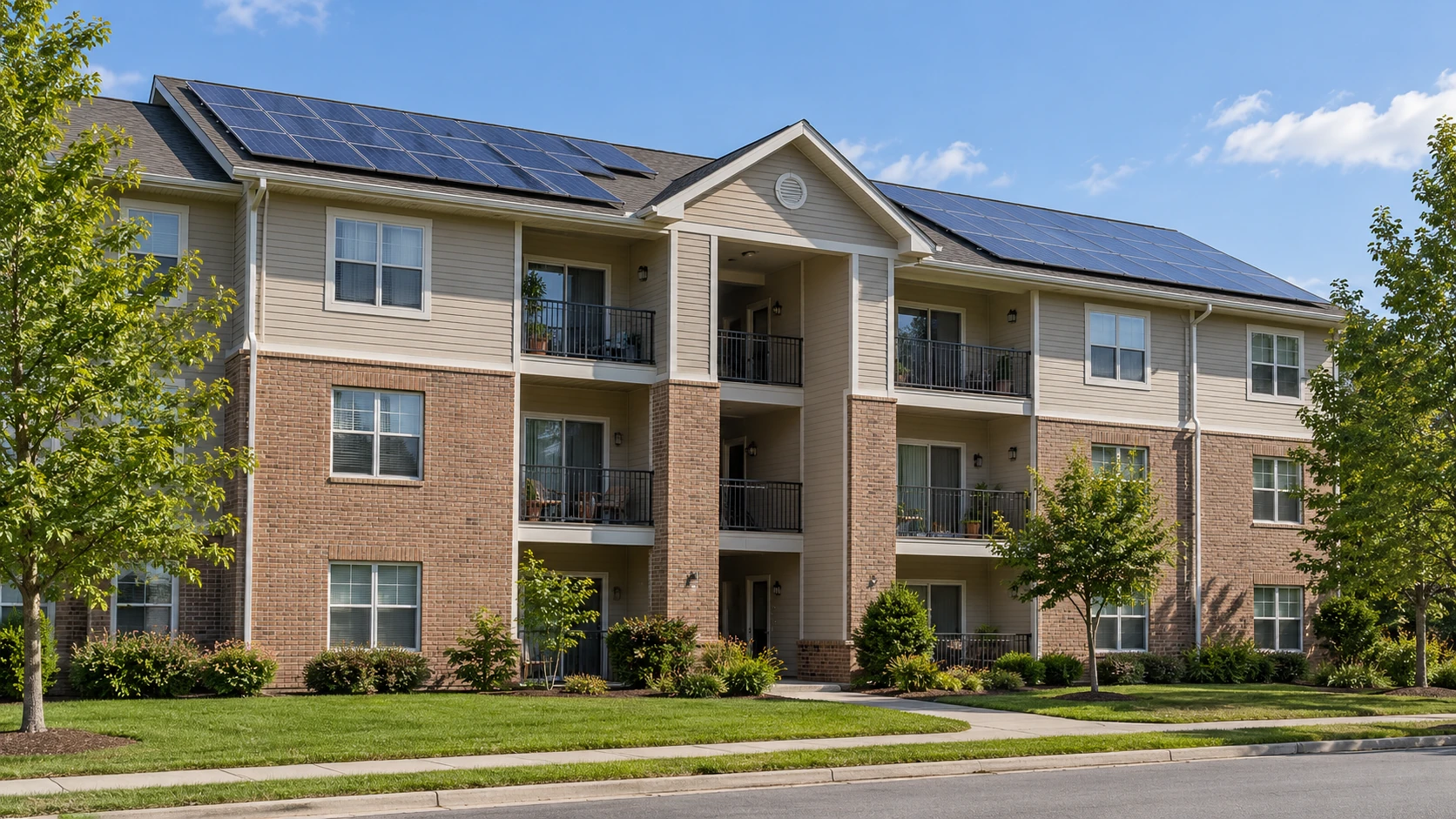
If you’ve researched solar for apartments or rental homes, you’ve probably noticed that almost every article assumes you own the roof. The advice is written for homeowners. The tax credit guides are written for homeowners. Even the “beginner’s guide to solar” results assume you’re the one signing the installation contract.
This guide covers what actually works for solar panels for renters — apartment dwellers, house renters, condo tenants. There are three realistic paths: community solar programs, portable panels for house renters, and talking to your landlord about building-level solar. Which one applies to you depends on where you live and what kind of place you rent. The comparison table below maps your situation to the right starting point.
This guide focuses specifically on renters. For the full picture on solar costs, installation, and decisions for homeowners, the solar panels for homeowners guide covers it all.
This page contains affiliate links. As an Amazon Associate, I earn from qualifying purchases at no extra cost to you. Amazon links are labeled #ad. Affiliate Disclosure.
Table of Contents
- Your options at a glance
- Find your solar option (tool)
- Why rooftop solar isn’t an option for most renters
- Community solar: how it works and why it’s the right starting point
- Community solar availability: where it works
- Before you sign: what to check in a community solar contract
- If you rent a house (not an apartment)
- The federal tax credit: honest answer for renters
- Utility green energy programs: the simplest fallback
- Frequently Asked Questions
- Conclusion
Your options at a glance
Find your situation in the left column. This table is a decision shortcut — each option is explained in full below.
| Your situation | Best option | Upfront cost | Typical annual savings | Requires landlord? |
|---|---|---|---|---|
| Apartment renter, any state | Community solar (if available) Transferable within utility territory | $0 | $100–$500 | No |
| Apartment renter, no community solar in your state | Utility green energy program Transferable (opt in again at new address) | $0–small premium | None direct (offsets only) | No |
| House renter with outdoor space | Community solar + portable panels for small loads Panels move with you; community solar transferable | $0 + $300–$1,500 optional | $100–$600 combined | No (community solar) / Usually (portable) |
| Long-term renter in a multi-family building | Ask landlord about building solar Not transferable — tied to building | $0 | Varies | Yes — landlord must initiate |
Use the tool below to find your best starting point.
Find Your Solar Option
Answer two questions to find your best starting point.
What type of place do you rent?
Why rooftop solar isn’t an option for most renters
Traditional apartment solar panels or rooftop installations require ownership of the roof and a long-term financial commitment, typically spanning a 25-year panel lifespan. Installers won’t work with renters because renters have no right to attach permanent equipment to the building and can’t guarantee they’ll be in the same unit in year two.
Beyond access, the economics don’t work. A rooftop system costs $15,000–$30,000 before incentives, with a payback period of 7–12 years. That math only makes sense if you’re going to stay in the same building long enough to recover the investment. Community solar exists precisely because most people who want solar can’t put panels on their roof — according to the U.S. Department of Energy, nearly half of all households and businesses are unable to host rooftop solar systems.
Community solar: how it works and why it’s the right starting point
Community solar works through a large solar farm, usually on farmland or a commercial site outside of town, that sells its energy to the local grid. Subscribers sign up to receive a share of that energy and get a credit on their electric bill for it.
You don’t install anything, and you don’t need your landlord’s permission. Your electricity provider stays the same. If the program applies credits to your utility account, the statement and subscription charges determine your net cost; the credit may not equal your share’s full generation value.
How the billing actually works
Here’s where most articles leave readers confused. The mechanics are straightforward once you see them laid out:
- A solar farm produces electricity and sells it to the grid.
- Your subscription entitles you to credit for a portion of that production — say, enough to cover 50–100% of your monthly usage.
- Your utility applies that credit to your electricity bill, reducing what you owe.
- You pay the provider a slightly lower rate than your standard utility rate: typically 5–15% less.
- The difference is your savings.
There is no standard discount or annual-savings amount. Compare the provider’s projected bill credits with subscription fees, utility charges and other costs using your own bills. Ask how the discount is calculated and whether any estimate is guaranteed in writing.
One thing that surprises new subscribers: once you enroll, you’ll often receive two separate bills each month — one from your regular utility (reduced by your solar credits) and one from the community solar provider charging you the discounted rate for your share. This is normal, not a billing error. Think of it like a cable bill and an internet bill arriving separately even though both reduce what you’d otherwise pay a single provider. The net result is lower total spending, even if the paperwork looks more complicated at first.
Who can sign up
Generally, you need to:
- Have an eligible electric account in a utility territory with an open project
- Be a customer of a utility that participates (most do in eligible states)
- Have a residential electricity account in your name
Home ownership is not always required, but eligibility can depend on your utility account, location, program rules and who pays the electric bill. Ask the administrator whether a renter with your account type can enroll and whether landlord or building approval is needed.
For renters researching solar for apartments, community solar can provide access without installing panels on the building. The contract, service territory and account arrangement determine whether it is available and whether it reduces the total bill.
Community solar availability: where it works
Community solar laws and installed projects are not the same as a subscription that is open to a renter today. Availability can depend on your utility, service territory, account type, project capacity and current enrollment. Check with your utility and the program administrator for your exact address before relying on a state-level summary.
Start with your utility’s current community-solar page or ask customer service whether an eligible project has open subscriptions for your account. Your state energy office or public utility commission may list local programs. NREL tracks community-solar projects and state policies, but its published market snapshot is dated through December 2024; use it for background, not current enrollment status. See NREL’s community-solar overview and the Department of Energy’s community-solar explanation.
Before signing, confirm who can subscribe, whether your electric account qualifies, how bill credits and fees are calculated, whether there is a minimum term, and what happens if you move or cancel. The contract and current program rules determine the result.
Low-income programs worth knowing about
Some community-solar programs include income-qualified enrollment, discounted subscriptions or other consumer protections. Eligibility and savings vary; do not assume a particular income cutoff, discount, no-cost offer or open enrollment. Ask the administrator for current requirements, documentation, waitlists and how credits and fees appear on the bill.
For households in HUD-assisted housing, ask the housing provider and program administrator how credits are handled under the applicable utility allowance. The Department of Energy’s community-solar guidance explains the issue.
Before you sign: what to check in a community solar contract
We’ve reviewed enough of these contracts to know that the difference between a good program and a frustrating one often comes down to three clauses most people skip. If you’ve received a solar subscription offer in the mail or seen one advertised, spend 10 minutes on these points before committing.
- Contract length: Is this month-to-month, one year, or a multi-year commitment? Month-to-month or 1-year contracts are lower risk.
- Early cancellation fees: What happens if you move or want to exit? Some contracts charge exit fees of $100–$300 or more. Others let you cancel or transfer without penalty.
- Savings guarantee: Is the discount a fixed percentage (e.g., 10% off your bill credits) or does it fluctuate? Fixed discounts are more predictable.
- Transfer on move: If you relocate within the same utility territory, can you take your subscription with you? If you move out entirely, can you cancel penalty-free?
- Who operates it: Is this a state-administered program or a private provider? Both can be legitimate — but confirm the provider is registered with your state’s public utilities commission.
- Bill credit clarity: Ask exactly how the credit will appear on your utility bill and when you’ll start seeing it (often 1–3 months after enrollment).
Programs that follow DOE best-practice guidelines disclose all of this upfront in plain language. If a provider refuses to answer any of these questions before you sign, that’s your signal to walk away.
If you rent a house (not an apartment)
If you rent a standalone house or townhouse with a yard or garage, you have options that apartment renters typically don’t.
Portable solar panels
Portable solar panels paired with a compatible power station can be a movable way to power selected devices outdoors. Check your lease, landlord requirements, building rules, equipment limits and battery safety instructions before using them.
Portable panels can charge a compatible power station for selected plug-in loads, subject to the equipment’s ratings and available sunlight. Actual output varies with weather, orientation, temperature and losses. Do not connect portable equipment to household wiring or a grid-connected outlet unless the equipment, utility, applicable rules and a qualified electrician permit that connection.
What they’re not good for: Powering a whole house. A typical house uses 30 kWh per day. You’d need 15+ portable panels to approach full coverage, at which point the ROI math falls apart compared to just enrolling in a solar program. (We haven’t done a rigorous side-by-side test of portable panel brands — for specific product comparisons, verified buyer reviews will serve you better than we can here.)
Portable equipment pricing and savings vary widely. Compare the panel, battery or power station, cables, intended loads and lease restrictions; do not assume a fixed payback. Community solar, where available, has a different billing model.
Best for house renters: Renogy 200W Foldable Panel — no roof mount needed, moves when you do.
Sets up in a yard or driveway. Pairs with any power station. Removes without a trace when you move.
Grid-interactive balcony solar is different from a portable panel charging a power station. Do not connect a generic inverter to a household outlet or wiring. Before considering any grid-connected plug-in photovoltaic system, verify that the exact product is certified to the applicable safety standard and that your utility, local authority, lease and building rules allow it. UL Solutions describes the safety issues and its UL 3700 framework for these systems.
Talking to your landlord about building-level solar
If you rent a house or apartment, you can ask the owner whether building-level solar is under consideration. The owner controls the roof and property work; any benefits, costs or tenant bill credits depend on the project design and written agreements.
A property owner considering solar should ask a qualified tax adviser about current incentives, ownership, project timing and eligibility. Neither a tax benefit nor an increase in property value is guaranteed. Bring the landlord information about local incentives and the building’s practical constraints.
If you rent a house and are serious about cutting energy costs while you wait on solar access, an energy audit is a practical first step. Our home energy audit guide covers what to look for and what it actually costs.
The federal tax credit: honest answer for renters
The federal Residential Clean Energy Credit (Section 25D) is not allowed for expenditures made after December 31, 2025, under current law. Earlier qualifying expenditures follow their own timing and filing rules; see the IRS guidance.
For renters, this change is less significant than it sounds. Whether a tenant could claim the credit depended on who paid for and owned qualifying property and on the residence and other statutory rules; being a subscriber to a community-solar project did not by itself make a renter eligible.
A subscriber’s potential savings usually come from bill credits and the subscription terms. Project owners may be eligible for different tax incentives; those do not automatically become a personal tax credit for the subscriber. Availability and net savings depend on the specific program and contract.
For the full history of what the credit covered and what changed at the end of 2025, see our guide to the federal solar tax credit.
Utility green energy programs: the simplest fallback
If neither community solar nor a shared solar program is in your state or utility territory, most utilities offer a “green energy” or “renewable energy” rate option. You opt in, pay a small premium on your electric bill (typically $5–$15/month), and your utility matches your electricity usage with renewable energy credits, usually wind or solar from somewhere in your region.
This doesn’t reduce your bill: it’s a premium, not a discount. And it doesn’t mean solar energy is physically flowing to your home. But it does support renewable energy development and lets you credibly say your home runs on renewable electricity. It’s also the easiest option to access: usually just a checkbox in your utility’s online account settings.
Frequently Asked Questions
Conclusion
Renting doesn’t lock you out of solar. For most people searching for solar for apartments, community solar programs are the right starting point: no installation, no landlord required, and real monthly savings in states where they’re active. If you rent a house with outdoor space and plan to stay for several years, portable panels are a viable supplement. And if community solar hasn’t reached your state yet, a utility renewable-energy option may be available; check its current price and terms.
The next step depends on your situation. Apartment renters: search “[your state] community solar” or call your utility this week. House renters: start with that same search, then check your lease terms before pricing out any portable equipment. Either way, the market is expanding — what’s unavailable today may open up in the next 12–18 months.
When you’re ready to own, the full solar panels for homeowners guide covers everything from system sizing to installer selection.
The information on this page is for general educational purposes and reflects our independent research. Community solar programs, contract terms, and state availability change frequently — verify current details directly with your utility or state energy office before enrolling. This is not financial or legal advice.